How State Laws Define Who Can Vote by Mail
Eligibility for mail-in and absentee voting remains a matter of state jurisdiction.

Federal filings have clarified that the authority to determine who can vote by mail does not rest with the federal executive branch,
but rather with individual states.
This legal framework ensures that state and local officials retain control over voter eligibility and ballot processing.
The core principle is straightforward: state law governs these processes.
There is no uniform federal standard for who qualifies to request or cast a mail ballot. Instead, each state establishes its own rules.
These rules define the specific conditions under which a resident may vote by mail.
State officials are responsible for two critical determinations:
- Voter Eligibility: They decide which voters are permitted to use the mail-in method. This can range from universal eligibility to strict requirements for excuses.
- Ballot Validity: They determine which ballots are eligible to be counted. This includes verifying signatures, deadlines, and other procedural requirements.
This decentralized approach means that a voter’s ability to participate via mail depends entirely on their state of residence.
One state may allow all registered voters to receive a ballot automatically,
while another may require a specific reason for absentee voting.
The local officials in each jurisdiction enforce these distinct rules.
The legal record confirms that this structure persists.
Filings in recent litigation have reiterated that state and local authorities maintain this power.
There is no indication in the provided evidence that this authority has been transferred or altered at the federal level.
The responsibility for defining the electorate’s access to mail voting remains firmly with the states.
Consequently, voters must look to their local election laws to understand their rights.
The federal government does not set a single national policy for mail-in voting eligibility.
Instead, the patchwork of state laws creates a varied landscape across the country.
This division of power is a fundamental aspect of the current electoral system.
The evidence provided does not specify any changes to this arrangement, nor does it detail the specific laws of any particular state.
It only confirms the general rule that state law governs the process.
The Postal Service’s Limited Role in the Voting Process
The Postal Service’s involvement in elections is strictly logistical.
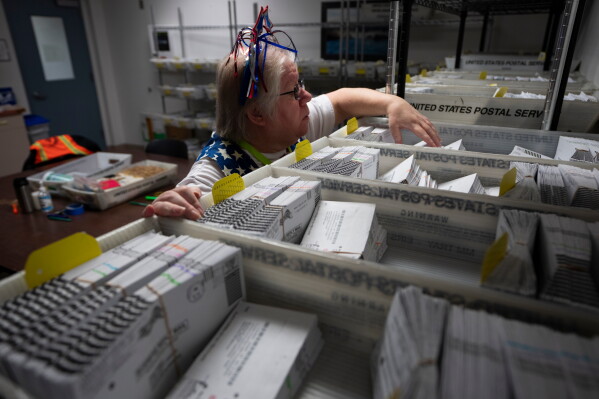
It does not decide who may vote, it does not maintain voter registration lists, and it does not count any ballots.
Those functions remain with state and local election officials, not the United States Postal Service.
A federal judge, Indira Talwani,
recently extended a court order that blocks the Postal Service from enforcing President Trump’s executive order aimed at changing how mail voting would be handled for the November elections.
The ruling reinforces the agency’s limited, non‑regulatory role.
In practice, the USPS’s duties are limited to transporting ballot envelopes and delivering them to the appropriate election offices.
Its workers handle the physical movement of mail‑in ballots, but they have no authority over voter eligibility, roll maintenance,
or tabulation of results.
Legal Challenges: Constitutionality and Court Battles
Democratic‑led states and a coalition of voting‑rights groups have publicly argued that the recent changes to mail‑in voting procedures violate the Constitution.
Their challenge centers on the claim that the alterations undermine voters’ equal protection and due‑process rights,
although the specific constitutional provisions cited have not been detailed in the available reports.
The ACLU’s Voting Rights Project, representing many of those groups, has taken a leading role in the litigation.
Sophia Lin Lakin, the project’s director, described the Postal Service rule governing the changes as “unconstitutional,
” reinforcing the broader assertion that the policy oversteps legal limits.
In response, the Trump administration has appealed the lower‑court decision that upheld the rule, seeking review by the Supreme Court.
The appeal underscores the administration’s position that the rule is lawful and that the challenges lack constitutional merit.
Both the states’ lawsuits and the ACLU‑led effort remain pending before the courts,
with the Supreme Court’s potential involvement marking the next critical stage in the dispute.
Implementation Hurdles and Timeline Pressures
Election officials have warned that the administration’s push to tighten mail‑in voting rules faces a fundamental timing problem.
According to reports on September 6, 2026,
the White House’s request to impose new restrictions cannot be met because there simply isn’t enough time left in the election calendar to implement the changes.
Officials point to the short window between the announcement of the proposed rules and the upcoming midterm ballots,
noting that the logistical steps—updating ballot‑mailing procedures, training poll workers, and informing voters—require weeks,
if not months, of preparation.
The reality check underscores a key implementation hurdle:
the mismatch between political ambition and the practical deadlines that govern election administration.
Without sufficient lead time, the proposed restrictions risk being incomplete or unenforceable,
leaving the existing mail‑in voting framework largely unchanged for the imminent elections.